Crawl4AI
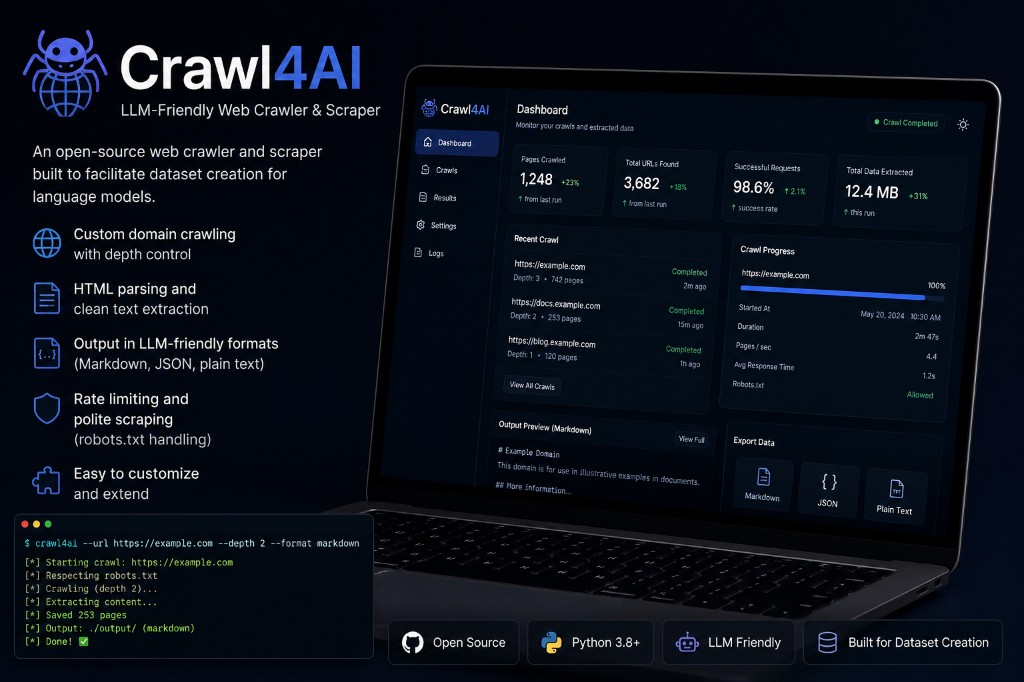
An open-source, production-ready web crawler built for the LLM era — extracts clean structured content from any website and outputs it in formats ready for AI pipelines.
Overview
What it does
Crawls any URL (including JS-rendered SPAs) and extracts clean markdown, structured JSON, or schema-validated data in formats directly consumable by LLMs and vector databases.
Problem solved
Traditional scrapers return raw HTML — noisy, full of nav/footer boilerplate, and token-wasteful for LLMs. Crawl4AI outputs only the meaningful content in clean formats.
Built for
AI developers building RAG data pipelines, ML engineers constructing training datasets, and researchers automating web-scale data collection for NLP tasks.
Crawl4AI uses Playwright under the hood, giving it full JavaScript execution capability. This means it correctly handles React/Vue SPAs, infinite scroll, and lazy-loaded content that simpler requests-based crawlers miss entirely.
The extraction layer supports multiple strategies: a default CSS selector strategy for targeted content, a cosine similarity semantic filter that retains only content most relevant to a given topic, and an LLM-based strategy that uses a language model to extract structured JSON from unstructured pages.
Technical Architecture
Crawl pipeline
Extraction strategies
- ▸NoExtractionStrategy — raw cleaned markdown
- ▸CosineStrategy — semantic relevance filtering
- ▸LLMExtractionStrategy — structured JSON via LLM
- ▸JsonCssExtractionStrategy — CSS selector mapping
Output formats
- ▸Clean Markdown (optimized for LLM tokenization)
- ▸Structured JSON with schema validation
- ▸LangChain Document objects (drop-in for loaders)
- ▸Metadata: title, URL, word count, crawl timestamp
Key Features
JS-rendered SPA support
Playwright executes JavaScript before extracting content — handles React, Vue, Angular apps that simple scrapers miss.
Async batch crawling
Crawl hundreds of URLs concurrently with asyncio — configurable concurrency limits and retry logic.
Content filters
Tag exclusion lists automatically strip nav, footer, ads, and scripts — only the article content remains.
LangChain-compatible output
Results are structured as LangChain Document objects — drop directly into any vector store or chain.
Challenges & Solutions
Handling JavaScript-heavy SPAs
Challenge: Modern web apps render content entirely in JS — a requests + BeautifulSoup approach returns an empty shell.
Solution: Playwright launches a real Chromium browser, waits for the networkidle event, then takes a DOM snapshot — guaranteeing fully rendered content every time.
Output noise and boilerplate removal
Challenge: Web pages contain 60–80% non-content: nav, sidebars, footers, cookie banners, ads. Feeding this raw to an LLM wastes tokens and degrades retrieval quality.
Solution: A configurable tag exclusion list combined with a word-count threshold removes low-content nodes. The Cosine extraction strategy adds a second pass that semantically filters remaining chunks by relevance to the target query.
Rate limits and blocking
Challenge: Aggressive crawling triggers rate-limits and IP blocks from target sites.
Solution: Built-in jittered backoff, configurable request delay, user-agent rotation, and a semaphore-based concurrency limiter that respects robots.txt.
Results & Impact
100+
Concurrent URLs
4
Extraction strategies
Open
Source license
Crawl4AI's LangChain-compatible output means it plugs directly into any RAG pipeline without any conversion layer. The project is production-ready and actively maintained, with plans to add screenshot capture, PDF extraction, and a REST API wrapper for non-Python consumers.
What I'd do differently
- →Smarter content/navigation boundary detection. The current tag exclusion list is manually configured. A trained classifier for content vs. navigation blocks — even a simple logistic regression on text density and DOM depth — would generalize better across sites without per-site config.
- →Built-in crawl state persistence. Large crawl jobs (500+ URLs) need checkpointing. If the process dies at URL 400, you lose everything. A SQLite-backed queue with completed/pending/failed states would make multi-hour crawls resilient.
- →Expose a REST API from the start. Python-only access limits adoption. A FastAPI wrapper with a simple
POST /crawlendpoint would open the tool to non-Python stacks and enable use from CI pipelines.
Code Highlight
Async batch crawl with semantic content filtering — two lines to go from URLs to clean LLM-ready markdown.
import asyncio
from crawl4ai import AsyncWebCrawler
from crawl4ai.extraction_strategy import CosineStrategy

async def crawl_docs(urls: list[str], topic: str) -> list[str]:
    strategy = CosineStrategy(
        semantic_filter=topic,
        word_count_threshold=20,
        max_dist=0.2        # cosine distance threshold
    )

    async with AsyncWebCrawler(verbose=False) as crawler:
        tasks = [
            crawler.arun(
                url=url,
                excluded_tags=['nav', 'footer', 'aside', 'script'],
                remove_overlay_elements=True,
                extraction_strategy=strategy
            )
            for url in urls
        ]
        results = await asyncio.gather(*tasks)

    return [r.markdown for r in results if r.success]